The amount of energy a car expends against air resistance is approximately given by
E = 0.2 ρ air ADv 2
where E is measure in Joules. ρ air is the density of air (1/2 kg/m 3 ). A is the cross-sectional area of the car viewed from the front (in m 2 ), d is the distance traveled (in m), and v is the speed of the car (in m/s). Julie wants to drive from Tucson to Phoenix and get good gas mileage. For the following questions, assume that the energy loss is due solely to air resistance and there is no wind.
(i) If Julie increases her speed from 30 mph to 60 mph, how does the energy required to travel from Tucson to Phoenix change?
Text Solution
Verified by ExpertsCHECK THE SOLUTION.
Ans.
(i)
Sol. If v increases by a factor of 2, then the required energy increases by a factor of 2 2 = 4.
(ii)
Sol. If Julie increases her speed by 20%, then she multiplies her speed by 1.2. Thus the required energy is multiplied by (1.2) 2 = 1.44, which is an increase of 44%.
(iii)
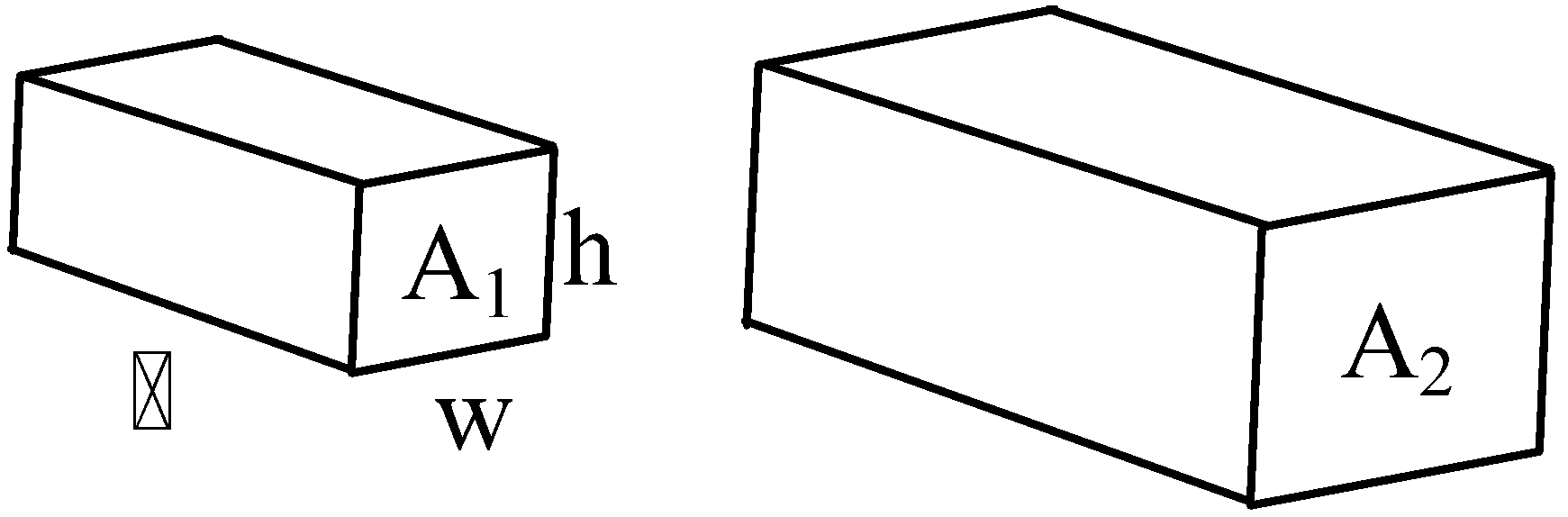
Sol. Comparing Scott’s car to Laura’s, all the linear dimensions are increased by a factor of 2 (see figure). The cross–sectional area A is width times height (A = hw), so if both h and w increase by factor of 2, then A increases by a factor of 4. Thus the required energy increases by a factor of 4, the increase in length does not matter.
Prepare Smarter with CGP Edu
Get practice questions, solutions, and test series in one place.
Write a Review
Share your experience with this question and solution.
Commentary
Send your comment, doubt, correction, or feedback to admin.
Similar Questions
Explore conceptually related problems